
The Hearts That Shift
Palm Sunday, Year A
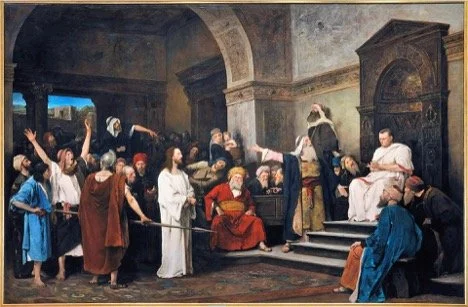
Christ in front of Pilate. By Mihály Munkácsy. 1881.
I always find it difficult to know where to stand on Palm Sunday.
It begins with celebration. Cloaks on the road. Branches in the air. Voices crying out, “Hosanna… Blessed is the one who comes in the name of the Lord” (Matthew 21:9, NRSVUE). There is energy and hope and a sense that something long-awaited is finally happening.
Then, almost without warning, the story turns.
Before the week is over, the same city that welcomed Jesus will watch him be handed over, mocked, and crucified. The voices grow quieter. The crowds thin out. Even the disciples scatter.
Palm Sunday does not let us stay in one place. It holds celebration and suffering together and asks us to sit with both.
It is easy to read this and wonder how it happened so quickly. How do people move from “Hosanna” to silence? How do the disciples, who walked so closely with Jesus, end up running away?
But the longer we sit with the story, the harder it is to keep a safe distance from it.
Because this movement is not unfamiliar.
There are moments when following Jesus feels clear and full of life. When hope comes easily. When we can name what God is doing and where things seem to be headed.
Then there are other moments.
Moments when things do not unfold the way we expected. Moments when something you were sure God would do… doesn’t happen. When prayers go unanswered. When the path forward feels uncertain and you realize you have less control than you thought. When doing the right thing actually makes your life harder, not easier. When following Jesus begins to cost something we were not prepared to give.
In those moments, something in us shifts.
We may not shout “Crucify him,” but we do pull back.
We grow quiet.
We become cautious.
We keep our distance.
If we are honest, our posture toward Jesus is not always steady. It moves with our circumstances, our expectations, and our fears. We can be hopeful, conflicted, and afraid all at once. Sometimes all of that shows up in the same day. Sometimes in the same afternoon.
The crowd is not just the crowd.
The disciples are not just the disciples.
We are with them.
Their instability is not unlike our own.
The Passion story makes this even clearer. The disciples do not just misunderstand Jesus. They abandon him. One betrays him. One denies him. The others scatter into the night.
These are the ones who knew him best.
Still, they cannot hold steady.
When fear rises, when the future becomes uncertain, when the cost becomes real, they buckle.
We do too.
Yet, set alongside all of this, the Scriptures give us another picture.
Isaiah speaks of the servant who does not turn back. “I gave my back to those who struck me… I did not hide my face from insult and spitting” (Isaiah 50:6, NRSVUE). Not because suffering is easy, but because trust runs deeper than fear. “The Lord God helps me; therefore I have not been disgraced” (50:7).
Paul describes Christ in the same way. “He emptied himself… he humbled himself and became obedient to the point of death… even death on a cross” (Philippians 2:7–8, NRSVUE). Where we grasp for control, Jesus releases it. Where we protect ourselves, Jesus entrusts himself to God.
In all the places where we tighten, withdraw, or turn away, Jesus remains steady.
This is the part that is both beautiful and uncomfortable, because I want to be like that.
I want to be steady in my love.
Steady in my trust.
Steady for my community, my family, and even myself.
But I am not always that person.
My trust rises and falls.
My clarity comes and goes.
My courage is not always there when I need it.
This year I am wondering if maybe the invitation on Palm Sunday is not to pretend otherwise.
Not to force a steadiness we do not yet have.
Not to rush past the parts of us that are afraid or uncertain.
Not to clean up the movement in our own hearts.
But simply to notice it.
To see, with a kind of honesty, how quickly we shift.
How easily we move between hope and hesitation.
How much we want Jesus on our terms.
Then, instead of pulling away, to stay.
To stay near to the one who does not shift.
Because while our posture toward Jesus may change, his posture toward us does not.
He enters Jerusalem knowing where this road leads.
He remains at the table with those who will fail him.
He stays when others leave.
He entrusts himself to God, even in suffering, even in death.
I want to be more like Christ, and I think that desire is pleasing to and blessed by God.
For now, though, I rest in Christ’s steadiness.
I rest in the one who remains faithful when I am not.
I rest in the one who does not turn away when I do.
I rest in the one whose love does not rise and fall with my own.
Palm Sunday invites us to see ourselves clearly, not so that we can try harder, but so that we can remain.
So this week, as we walk from palms to passion, perhaps the invitation is this:
Pay attention to what is in you.
Notice where your heart feels steady, and where it shifts.
Do not hide from it.
Then, stay near to Jesus anyway.
The one who enters in humility is the same one who remains faithful to the end.
It is in the noticing and the surrendering that our formation begins.
Formation flows from grace.
The fruit comes from abiding in the steady faithfulness of Christ.
We become like Jesus by remaining in and resting in Jesus, not by trying harder on our own.
Lord, in your mercy,
hear our prayer.