
Resurrection and Life
Fifth Sunday in Lent, Year A
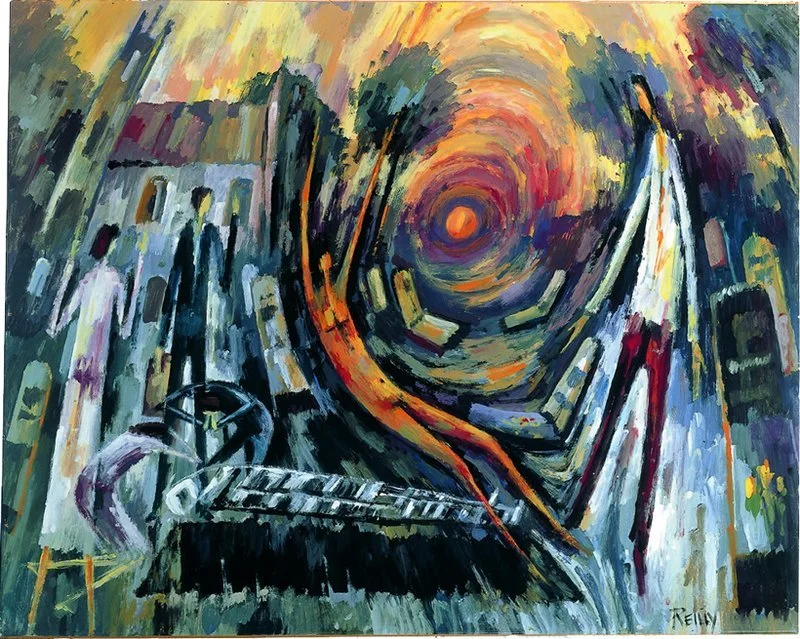
“The Raising of Lazarus,” by John Reilly
Ezekiel 37:1-14 | Psalm 130 | Romans 8:6-11 | John 11:1-45
For a variety of reasons (a disappointing number of them being tied to commercial and economic realities), practices surrounding death and burial, the ways that people gather to remember and honor those who have died, have changed dramatically in recent decades. In the time and place where I grew up, it was fairly common, when a loved one died, for there to be two days (often long days) of visitation, where the family could gather for the receiving of friends, the telling of stories, and the sharing of memories, all in a context of shared grief and compassionate ministry to one another. As a child, I distinctly remember how special some of these times were. Because I came from a fairly large extended family, there weren’t many occasions when we all got together. We saw each other most Thanksgivings and Christmases, and every funeral. As I heard my older cousins say on more than one occasion, “You don’t miss a funeral.”
Often, these times together provided opportunities not just for us to catch up, but also to express the kinds of things we didn’t often talk about over plates of turkey at Thanksgiving or among the piles of wrapping paper on Christmas. Those long days spent at the funeral home allowed for some of our most vulnerable, most raw emotions to be on display. Occasions like that have a way of drawing out of us some of our most honest expressions of anxiety, sadness, doubt, and fear.
The gospel passage from this week unfolds in the context of just such an occasion. Jesus’ friend, Lazarus, has died. And if Jesus couldn’t, or wouldn’t, travel to the sickbed of his friend, he was not going to miss the funeral. He was not going to be absent where those who loved Lazarus and his sisters were gathering. So he makes the trip to Judea, even in the face of fierce opposition from the religious leaders there, even if, as his own disciples intimate, he might be walking toward his own funeral. Jesus goes to be counted among the many visitors that Martha and Mary were receiving. He goes, like so many of these visitors, to offer comfort, to show compassion, to grieve alongside those he cares about so deeply. Famously, he goes to weep with those who weep. Of course, as he knew, and as we will find out, he also goes so that the glory of God might be revealed, and the victory of God might be made known, even in this profoundly difficult moment.
At the heart of this story, at the center of this account of Lazarus’ death, Lazarus’ funeral, and the miracle at Lazarus’ tomb, is an exchange, a conversation between Jesus and one of the sisters. It’s the kind of conversation that so often unfolds in moments like this one, when we are at our most vulnerable, our most raw, our most honest. It’s a moment of confession, a moment that provides space for Jesus to proclaim the truth about who he is, and also to reveal what that means for both the living and the dead.
When Martha hears that Jesus has arrived, she goes out to meet him, greeting him with a statement that is as heartbreaking as it is true: Lord, if you had been here, my brother would not have died. Yet I know that now, God will give you whatever you ask of him.” This is at the same time a cry of anguish and a confession of faith, a lament about what could have been and a declaration about the powerful relationship that Martha sees between this Rabbi from Nazareth and his heavenly Father. What follows, in the conversation between Martha and Jesus, will test this confession, and ultimately prove this confession. “Your brother will rise again.” When Jesus says this, he is giving voice to a conviction that points to the undeniable power of God over the grave. It’s an answer to the question posed to Ezekiel as he stood in that valley of dry bones: Mortal, can these bones live? Ezekiel had answered, “Oh Lord, you know,” and God had demonstrated his power to make it so.
Here, Martha professes her faith, her hope in the power of God to bring life even to the dead, in his time, according to his purposes: I know that my brother will rise again in the resurrection at the last day. Again, we should not discount or diminish the power of Martha’s confession here. Even as she mourns the loss of her brother, she places her hope in the belief that she will see him again, because of God’s promises that he has authority even over the grave. But even Martha might not have been fully prepared for what Jesus said to her next: “I am the resurrection and the life. Those who believe in me, even though they die, will live, and those who live and believe in me will never die.” In other words, Jesus is declaring that the hope that Martha has for the future, the conviction that God will work out his kingdom purposes on that appointed day, that isn’t just a far-off hope. The one standing in front of her, talking with her, is the embodiment of that hope. He is God’s resurrection power in the flesh. And to this, even in the midst of her grief, Martha gives voice to what is as profound a statement about Jesus’ identity that we have yet encountered: “Lord, I believe that you are the Messiah, the Son of God, the one coming into the world.”
When we profess our belief in God’s resurrection power, revealed in Jesus, when we speak these words in prayer or in song, we take our place with Martha who, even in her grief, even in this moment of raw vulnerability, makes a confession of faith that has endured. But like Martha, we have to remember that these words, this confession, should also root down into our lives in such a way that it prompts a response. In the words of Wendell Berry, we must also “practice resurrection.” When Jesus makes his way to the tomb and asks that the stone be rolled away, it is here that Martha hesitates. She has what seems to be a very reasonable concern: “What about the odor?” But Jesus makes clear that, in the face of God’s glory, in light of God’s promise of life, a bad odor, and the discomfort it might bring, shouldn’t be a concern. If, as Paul says, the spirit of him who raised Jesus from the dead is at work in us, then the inconveniences, the embarrassments, the disappointments, the anxieties of life shouldn’t prevent us from receiving what that God wants to give us, or from embracing what that God wants to do. When Martha and all of those at the grave took Jesus at his word, when they allowed their confessions of faith about who Jesus was to give space for Jesus to demonstrate who he was, they saw the glory of God. They saw a dead man walk out of the tomb and they saw Jesus, the resurrection and the life, triumph over the grave.