
Though I Was Blind, Now I See
Fourth Sunday in Lent, Year A
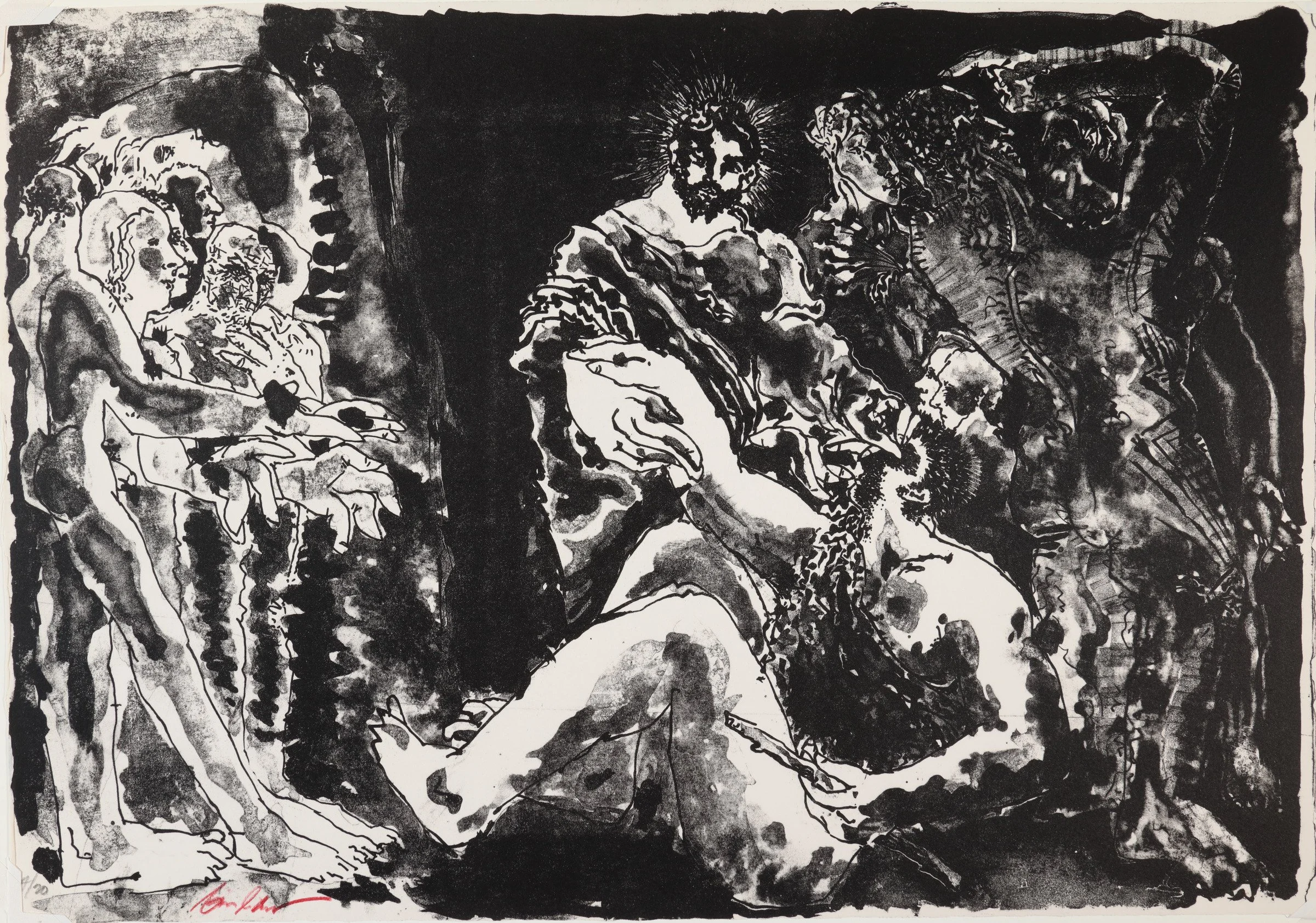
“Christ Healing the Man Born Blind,” Thomas Giuliano
1 Samuel 16:1-13 | Psalm 23 | Ephesians 5:8-14 | John 9:1-41
For the better part of two weeks, I’ve been drafting a reflection on this week’s Gospel, which tells of the healing of a man born blind. Having finished a semifinal version, I stood back to admire it. The theme of my reflection was how we interpret events through our own filters. I noted how Jesus disappears from most of the story, which spends much more time talking about reactions to and interpretations of the healing event (from eyewitnesses, the Pharisees, and the blind man and his parents) than on the healing itself. I included references to a classic Japanese film that tells its story from multiple perspectives. There was a fair amount of commentary on media coverage of current events, a perceptive observation made in conversation by my spiritual director, and at least two polysyllabic philosophy terms. I even made the case why, in my not-so-humble opinion, one of the statements attributed to Jesus is inauthentic. It was all quite clever and urbane, if I say so myself.
Which only I can say, because you, gentle reader, will never get the chance to read it. A couple of days ago I scrapped it, because it fell into the very trap I was trying to call out: by allowing other people to interpret events for us, we misconstrue facts or motivations, at the expense of the real power of the event. To put it another way, Version 1 of my reflection had not enough Jesus and too much me.
The proof I needed was how what kept running through my head was not anything I had to say, but the man’s testimony “I was blind and now I see,” –a truth so beautiful, so simple and yet so profound that John Newton borrowed it for the first verse of “Amazing Grace”. The more I thought about it, anything I could say would diminish rather than illuminate the power of the story, just as the Pharisees attempt to undermine the power of a miracle that occurred in plain sight.
Indeed, the healing story at the center of today’s reading is so powerful that it needs no third-party commentator. So, I suggest that, rather than paying attention to someone else’s observations on the story, you read it yourself, slowly. Read it two or three times, in your favorite translation. Then visualize the story, placing yourself in the scene. Imagine the sounds and smells surrounding the healing. Note the reaction of the Pharisees, the man’s mother and father, and the other witnesses to the healing, something “not heard of since the world began,” but pay more attention to your own. And then just sit with the story for a while. See what surfaces. Perhaps run that central phrase “though I was blind, now I see” through your head several more times, emphasizing the parallel words (though I was blind, now I see), then the temporal reference (though I was blind, now I see), and finally the pronouns (though I was blind, now I see). You will gain a new perspective on the story, and it will be your own. With any luck, your focus will move from how or why the healing happened but simply to the fact that it did happen. Don’t be surprised if at some point that phrase – “though I was blind, now I see” makes you shudder a bit, or even sit bolt upright in your chair.
The second part of my dust-binned reflection analogized this story to current events, and to our addiction to analyze, comment on, editorialize about them. (Don’t worry, they won’t be repeated here.) If you’re as tired as endless editorializing as I am, try a sort of visio divina with thew news. Think of it as a Lenten discipline, giving up punditry rather than chocolate or cabernet. Stop reading the editorial page. Either turn off cable news entirely or mute the sound. At all costs avoid anything labelled “analysis” or “commentary” or, especially, “for subscribers only,” (which means “algorithmically designed to give you a dopamine hit.”) Then, find some news outlets, including one you don’t regularly visit. (Make sure they’re legitimate ones, so that you’re not looking at phony images). Contemplate the photos that accompany the stories. The captions to the photos will give you all the context you need. Look at pictures of the wars in the Middle East, Ukraine, Sudan, and elsewhere around the world, especially the pictures of schools and hospitals blown to smithereens, celebrations or protests on the streets of Tehran, flag-draped caskets on the tarmac. Look at pictures of immigration detention facilities, of parents separated from toddlers, of high school mariachis in shackles, and of the violence surrounding immigration enforcement here in the States, including teargassed, beaten, or gunshot protestors. Of the Jeffrey Epstein victims standing silently in Congressional hearings. Of cartel violence in Mexico. Pay special attention to the faces: grieving parents, scared or starving children, faces of lament or outrage.
Imagine Jesus looking at these same images with you. Note his reaction, and yours. Is it anger, sadness, frustration, weariness? The images in the news are so powerful that they need no commentary. Yet, commentary will come to you, but it will be your own, or perhaps even the Holy Spirit’s. One thing is certain: you will focus less on the large canvas, and more on the individuals in the canvas. This exercise may also provoke a shudder, of the kind Thomas Jefferson felt when he said “Indeed I tremble for my country when I reflect that God is just, that His justice cannot sleep forever.”
Finish up with a prayer: the Lord’s Prayer, a Hail Mary, or a prayer of your own making. Or, just say, along with the healed man, “Lord, I believe.” The Pharisees tell the man “Give glory to God.” This phrase is the formal oath required of a witness in 1stCentury Judea – the equivalent of “tell the truth, the whole truth, and nothing but the truth.” And he does: “One thing I do know, that though I was blind, now I see.” From that truth flows the grace that allows the healed man to meet the Son of Man face to face. Try some quiet contemplation, and perhaps you will do the same. Don’t be surprised, if this “man called Jesus” looks you in the eye and asks, “But who do you say I am?” Try responding “you are the one that healed the man born blind.” In a time so desperate for healing, if we can know a truth that beautiful, perhaps that is all we need to know.