
Resurrection Peace
Second Sunday of Easter, Year A
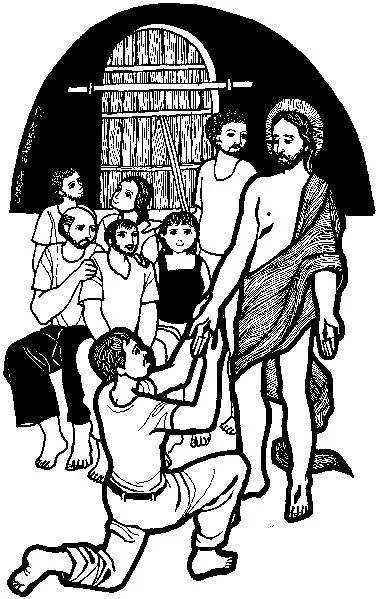
image by Father Maximo Cerezo Barredo
Acts 2:14a, 22-32 | Psalm 16 | 1 Peter 1:3-9 | John 20:19-31
My first Easter Vigil jolted me. It coincided with my first time participating in the Ignatian exercises. 1 My Ignatian cohort had spent most of Lent sitting with the Passion narrative and all of Holy Week contemplating Holy Saturday. So midway through the Easter Vigil, when the dark quiet of the bare sanctuary suddenly transformed into bright lights, gold banners, alleluias and bells ringing, I was quite disoriented. I wasn’t ready to make a sudden U-turn from sorrow to joy. That visceral response to the Resurrection has stayed with me. Jesus has defeated Death and ushered in a new world order. I know this to be true. Yet, like the disciples who had followed Jesus on the Way, I still smell the stench of Death and hate. Today’s version of the imperial powers that executed Jesus remains as potent as ever. This is the tension I feel every year. I want to linger at the empty tomb with Mary Magdalene, in her pre-dawn weepy, tender encounter with the Risen Jesus. Because here, Jesus whispers, “There is space in the Resurrection for weeping, unbelief, fear and disorientation. Right next to wonder and Life.”
On this second Sunday of Easter, we are invited to sit at the table with the disciples in the upper room. With their disorientation and wonder. To see, hear and touch the Crucified, Risen Jesus who pronounces peace. These are the men who saw Jesus heal the sick, heard His prophetic promise of redemption and declared Him Lord, the Messiah. Earlier that day, they heard Mary Magdalene announce, “I have seen the Lord!” Their first gut-response to the Resurrection? Retreat to the upper room. In the company of other Jesus followers. Behind locked doors.
Shrouded in a heavy fog of shame, fear and disbelief, the disciples don’t know what to do with themselves on this side of the Resurrection. So they hide out in the familiar place where Jesus shared His last meal, washed their feet and foreshadowed the details of his betrayal before He was taken. None of them (except for John, the gospel writer) had stayed with their Friend and Teacher when He was declared a terrorist and publicly executed by the Roman and religious authorities.
Then, in comes Jesus, still bearing the wounds of torture on His human body, yet in His divinity, risen from death. John writes, “Jesus came and stood among them and said, ‘Peace be with you.’” These are the first words that the Risen Christ speaks to his beloved friends. He repeats these words two more times. Why is “Peace be with you” the first thing Jesus says to a bunch of guys who abandoned Him in His darkest hours? What is this Resurrection peace that Jesus is offering?
There has been a lot of talk of peace in recent years. Perhaps because violence seems evermore blatant, pervasive and close to home and yet another war has erupted. Peace is one of those words that gets casually tossed around, yet everyone seems to mean something slightly different. For some, particularly in our churches, peace is equated with harmony, the absence of conflict. Others cling to the hollow assurance that “everything will be okay” because there won’t be true peace until Jesus returns anyway. Or there is the Americana version where we relegate peace to an inner peace within our hearts. And for those in this White House, their warped peace is achieved by “maximum lethality,”2 destroying all that threatens American wealth and power, by any means necessary.
Peace in the Scriptures is much thicker. In Greek, peace is eirēnē, derived from the root eirō, which means to tie, join, fasten or string together. For the disciples seeing and touching the wounds of the Risen Jesus for the first time, “Peace be with you” literally means shalom alechem, a pronouncement of wholeness and restoration for all of creation. Jesus doesn’t pop in and reassure his disciples, “Hey, cheer up. I’m alive. Everything will be okay.” Neither does he rebuke them for their failures or minimize their fear and disorientation. The shalom that Jesus offers is sheer grace. His disciples and those of us “who have not seen and yet have come to believe” did absolutely nothing to earn it. The Crucified, Risen Christ offers us a gift of peace that invites us to repent and forgive. A peace that is whole and wide enough to draw together all of creation.
As I have written in prior posts, locked doors remain a hauntingly familiar image in our present context of state-sanctioned terror against our immigrant communities. Immigrants locked in their homes, perhaps only leaving occasionally for work or to take their kids to school, for fear of immigration authorities lurking outside. The relentless cruelty unleashed against my frightened immigrant clients can de-center me from the Resurrection. Yet, this week’s gospel text reminds us that in the middle of injustice, our Wounded and Risen Jesus stands among us and proclaims, “Peace be with you.”
In the land that once held our Lord’s empty tomb, thousands of miles away, settler violence is relentlessly displacing Palestinians from their homes in the West Bank. They too sit behind locked doors, under the constant threat that armed Israeli soldiers will remove them from their beloved land that generations have called home. For many Gazans in the aftermath of a genocide, their locked doors are gone, beneath the rubble of bombed-out houses and schools and the bodies of neighbors and loved ones. How do the 117 million people who are being forcibly displaced around the world hear our Risen Lord’s proclamation, “Peace be with you”? 3
In the past several months, I’ve been leaning into the voices of Palestinian Christians. Their prophetic words and stories of decades-long suffering have challenged my western notions of Christian witness, solidarity and peace. As post-Resurrection disciples in a still-violent world, when we find ourselves fluctuating between outrage and despair and numbness, I wonder if our Palestinian siblings can help lead us forward. Munther Isaac, a Palestinian theologian and pastor in Bethlehem, writes:
In the Sermon on the Mount, Jesus didn’t say, “Blessed are the peace prayers.” He said, “Blessed are the peacemakers.”...When Christians hide behind slogans of peace and reconciliation to avoid taking sides, they serve the purposes of the aggressor. Taking sides can often be costly. Solidarity is by definition costly. Jesus never sought comfort or conformity. His ways were always controversial and sacrificial.4
Peace requires vulnerability and hope. As Lamma Mansour, a Palestinian Christian from Nazareth and a postdoctoral fellow at The Hebrew University of Jerusalem, affirms:
Our hope declares that the seeming victory of oppression is temporary, and in doing so, hope defies the arrogance of oppressors, of those who build walls and drop bombs and torture humans in detention centers. Our hope defies evil. It resists evil…Hope gives us the power to imagine a different reality…We need to do this work of imagination, not to be sentimental or to escape reality…But because if we fail to do so, others will fill the gap. Others will take up the task of imagining for us. Look at the current imaginations of our land. They are ones of exclusivity, of division, of supremacy.5
How do these words offered by our Palestinian siblings help us to receive and live into Jesus’ liberating invitation of resurrection peace? To have the courage to name injustice and speak truth to power. To repent of our distorted presumptions of peace. To consider costly solidarity with those who are oppressed. To expand our resurrection imagination of shalom – as beloved, forgiven followers of the Wounded and Risen Christ, aided by the Spirit and sent into the world. Christ is Risen. He is Risen indeed.