
Resurrecting Imagination
Fifth Sunday of Easter, Year A
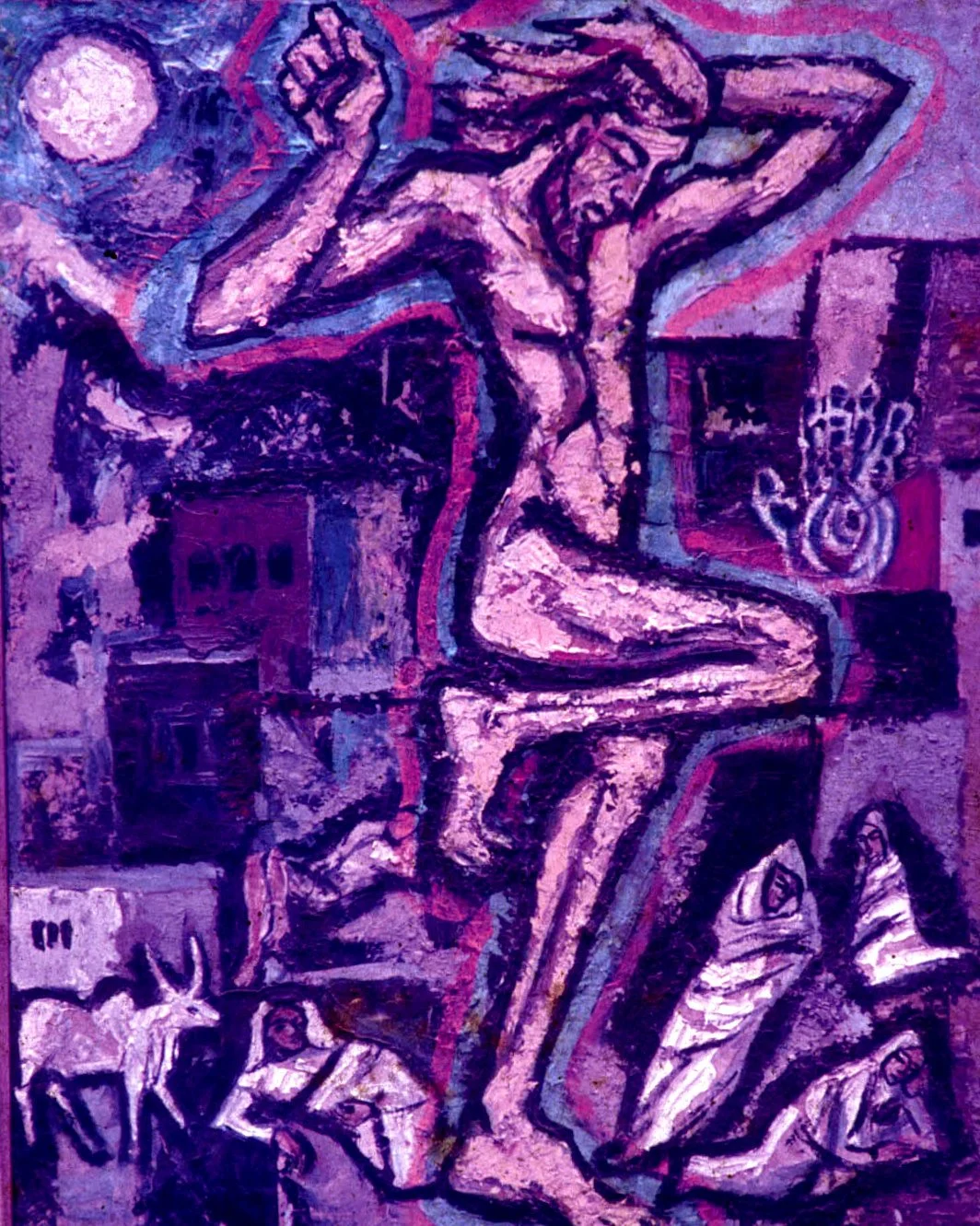
He Who Steps Over - The Tandavan, Jyoti Sahi
How does resurrection reshape our everyday lives?
With the lectionary’s emphasis on Jesus’ intimate presence and tender words in the Eastertide gospel readings, it is possible to focus solely on the resurrection’s personal and interior dimensions.
But Easter is also world-disrupting. It begins with a great earthquake (Matthew 28:2). Easter terror renders temple guards comatose (28:4) and sends the female disciples fleeing from the empty tomb (Mark 16:8). Luke and John’s resurrection narratives are brimming with tension and mystery. On Easter, Jesus demonstrates his bodiliness by eating his disciples’ food (continuity) because he moved effortlessly through their walls and locked doors (discontinuity). He continues to act as their rabbi by offering words of instruction and correction, yet his wounds elicit Thomas’ staggering confession that he is infinitely more: “My Lord and my God!” Jesus’ wounds simultaneously signify his shameful crucifixion but also God’s once-for-all conquest of the old order of Death.
How then can the cataclysmic resurrection reframe the ordinariness of our lives?
It is no accident that, for most of this Eastertide, the lectionary gives us readings from 1 Peter. This letter begins with an Easter acclamation:
Blessed be the God and Father of our Lord Jesus Christ! By his great mercy he has given us a new birth into a living hope through the resurrection of Jesus Christ from the dead. (1:3)
From the jump, the epistle wants to form us into an Eastertide people who live into the hope of our calling even in the midst of severe cultural pressure.
1 Peter aims to convert our imagination through the use of imagery. In his commentary, Eugene Boring observes that this epistle has one of the densest constellations of images for the church in the entire New Testament. 1 Peter unleashes a torrent of metaphors to fire our imaginations, so we can live out our identity as people of the resurrection.
As mentioned earlier, one of 1 Peter’s first images for what resurrection does to us is to grant us new birth. We are “newborn infants” who are poised to grow up into salvation if we feed upon the pure, spiritual milk (2:2). Birth is a messy, abrupt transition to a new kind of life. It marks the end of an old form of existence and the beginning of something utterly new. As Jesus’ conversation with Nicodemus in John 3 underscores, the educated, the privileged, or the comfortable cannot control or fathom this new birth. Resurrection life begins only because of the sovereign initiative of God who chooses and sparks new life in us.
New birth also implies growth from infancy. But growth toward what? Not growth according to the old blueprints or DNA. Not growth toward the old measures of status, security, or self-interest. “You have been born anew, not of perishable but of imperishable seed…Rid yourselves therefore of all malice, and all guile, insincerity, envy, and all slander” (1:23; 2:1). This new birth is entry into an existence in which the believers must shed perishable vices and put on the imperishability of a creation reborn in the resurrection. In an echo of Genesis, Luke and John underscore that Jesus’ resurrection takes place on “the first day of the week.” Easter is the birth of a new creation. The apostle Paul ties our new birth with new creation. Creation itself groans with us in labor pains (Romans 8:22). And “if anyone is in Christ – new creation! Everything old has passed away; see, everything has become new” (2 Corinthians 5:17). Far from being a solely personal or interior reality, Easter births us into participation in a new cosmic reality.
1 Peter’s image of newborn infants could signal to us notoriously autonomous Americans that each of us is born to run solo toward salvation. 1 Peter counters this misperception with another set of images. Resurrection looks not just like new birth but also like us collectively being built into God’s temple. 1 Peter employs the image of being joined to Christ like stones built upon the cornerstone of a great building. This image communicates several things all at once.
First, it says that resurrection looks like no longer living isolated, autonomous lives in which each of us pursues our own fulfillment or survival. Easter means we are joined to Christ and to his people. Resurrection means being joined to others to share in a destiny we could never know on our own. John Alexander, the late pastor of the Church of the Sojourners in San Francisco, wrote Being Church: Reflections on How to Live as the People of God. His original subtitle was “Stop Going to Church…and Become the Church.” To settle for an arm’s length or consumer relationship with the church is to stop short of entering into resurrection. We are incomplete and can never be fully alive without submitting to this building process.
Second, the image of being built into a “spiritual house” or temple radiates into a dazzling web of connected pictures, each of which underlines the corporate dimensions of resurrection:
Royal priesthood
Chosen race
Holy nation
God’s own people
1 Peter borrows from, without expropriating, Israel’s rich treasury of identities in order to invigorate the church’s imagination. The letter invites us to marinate in each of these images until they impart new affections and longings and guide us into new forms of congregational enactment.
One final image asserts that resurrection makes us strange. 1 Peter repeatedly names its audience as aliens and exiles. Again the letter borrows images from Israel’s story: Abraham was a migrant. His descendants sojourned in Egypt and the wilderness. The Jews were exiled among the nations. Because 1 Peter’s hearers are primarily Gentiles and not Jewish, its exilic imagery signals their radical change of status. Because Christ-followers are born anew into a new citizenship, they are no longer at home even in their own homelands (cf. the 2nd century Epistle to Diognetus). Resurrection hope produces deep dissonance and dislocation even as we remain in place.
In this time of great social and political upheaval, we may feel alienated from our nation and especially fellow believers. We are not at home. But 1 Peter does not use the imagery of exile to authorize a retreat into self-protective enclaves. The letter reframes our dissonance as an intrinsic element of becoming resurrection people and activates it toward bearing witness. Our new status as God’s resurrection people is not for private consolation but for public declaration of God’s mighty acts of mercy toward us (2:9). Exilic witness is offered openly but also vulnerably. Now more than ever, migrants know the tenuousness of their standing in our communities, and we would do well to learn from the immigrants among us how to live as resident aliens.
But as Easter people, we remain rooted in the wonder of God’s esteem for and vindication of Christ the rejected one and therefore, for us. In the midst of all of the pressures facing us, 1 Peter urges,
Live as God’s resurrection people among the Americans so that your way of life will pierce their blinders. Then, in the end, they may be won over and join in glorifying God when he at last comes to make all things new. (2:12)