
Born From Above and Resembling the Source
Second Sunday in Lent, Year A
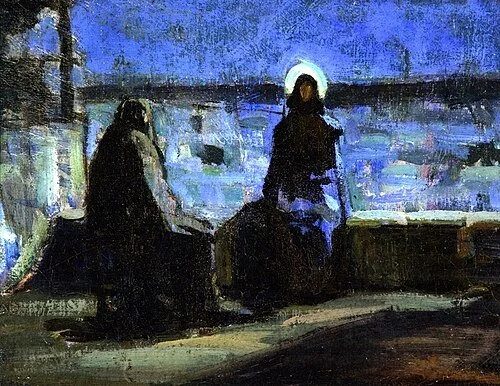
“Nicodemus Visiting Christ,” by Henry Ossawa Tanner
Genesis 12:1-4a | Psalm 121 | Romans 4:1-5, 13-17 | John 3:1-17
In a passage full of potentially confounding promises made about the kingdom of God (a concept notably missing throughout the remainder of this gospel account) and the nature of salvation, the greatest volume of speculation among scholars and preachers alike seems to revolve around Nicodemus’ motives for approaching Jesus, particularly at night. Any of these suggested motives supposedly constitutes the key to interpreting an admittedly complicated passage. Many of these are familiar: For one, Nicodemus approaches Jesus under the cover of night, timid that his questions might put his status within the Sanhedrin in jeopardy, if not formally, then at least in spirit. Others are confident that a visit at the end of the day is nothing more than a practicality, that Jesus is surrounded by disciples throughout the day, so a visit at this hour would have been the best way to ensure Jesus’ full attention (a desire, we may wonder, that Nicodemus regretted). Still others chalk the visit from Nicodemus up to administrative due diligence, a necessary investigation into Jesus’ teaching to, if nothing else, see what all the fuss is about.
Since it is only right, then, to offer my own reading as to Nicodemus’ rationale, and thus surely unlock the secrets of this passage’s meaning, I wonder if we can imagine that this Jewish leader’s motivation was, in fact, investigation, but not for any administrative purpose, but rather from a posture of curiosity. Perhaps the great meaning behind the night time visit was nothing more and nothing less than that Nicodemus wasted no time in approaching Jesus. If what he had heard about this radical carpenter was true, and that the title “Rabbi” still applied, then perhaps, in Nicodemus’ mind, there could be something to learn from this man, though he would still need to be convinced, of course.
No matter what kind of information we believe Nicodemus sought in coming to Jesus, what we can say is that what he received from his “teacher” was a lot less like information and a lot more like revelation. Nothing he heard resembled the kind of response he was expecting, in either form or function. We can almost imagine Nicodemus barely keeping his footing as the ground underneath him becomes less and less steady. Still, Nicodemus remains steadfastly curious. What he might have expected to be a dialogue on familiar terms quickly became an occasion for his imagination to be greatly broadened. Without the benefit of thousands of years of Christian formation and societal influence that we enjoy today, we might only hope to be as curious as Nicodemus remained throughout this interaction. His posture is, in fact, one we can learn from.
To be sure, Nicodemus had every reason to cease his line of questioning. The claims that Jesus was making, not the least of which being the instruction to undergo new birth, were not just impossible, which would have been forgivable; they were also out of step with every expectation with which Nicodemus arrived. Of course, one who comes from God can perform signs that would otherwise be impossible, but the real stretch for this curious man was that a life well lived unto God was not marked by constant and diligent improvement and internal refinement, but rather a totally new birth. One commenter helpfully makes the distinction this way: Nicodmeus arrives expecting that his highest calling is to be a continually improved caterpillar, while Jesus invites us all to the becoming that results in a butterfly. Birth from above implies not some kind of improvement or rearrangement of what already exists, but something different, something, as we know from the tangible births in our families and communities, that bears resemblance to source, taking on characteristics that render it familiar. Like a father’s eyes or mother’s strength, our new birth allows us to resemble the one from whom we are born.
Also important to note, as surely Nicodemus was surprised to hear, that the process of new birth is one that is frustratingly, at least for many, passive. “You must be born from above” allows us precious little capacity. Birth is something that happens to us, not against our will, but rather as a facilitation of who we are becoming. It would be easy to confuse a new birth with the perpetual cycle of self-improvement that dominates social media feeds and self-help bookshelves. An attitude best identified by the phrase “new year, new me” seems to be the only acceptable path to progress in our lives. Being born from above is an opting into an invitation of newness of life, one that begins not within but above. It is sustained by God’s blessing, the same blessing on a born anew people in the Old Testament reading this week. New birth, thanks be to God, is decidedly something that we cannot do for ourselves. Self help falls flat, it seems, in the face of divine revelation.
Friends, it can seem odd to talk about new life in the beginning days of our Lent observance, but I doubt many have to be convinced that a new life born from above necessitates the death of something else. What the “something else” is may be painful or subtle, but no matter the case, we have an invitation - an invitation to enter the mystery of the spirit’s movement. Even a new birth, often marked by a specific date and time in our memories, brings with it a gestational period. New birth does not require full understanding. The invitation from Jesus to Nicodemus is to enter into the dynamic breath and wind of the Spirit, the kind that is sure to carry us through this season of dying to ourselves, consenting to a new birth that happens to us, bearing the appearance and constitution of the source, and sharing in the promise of kingdom life with that source for eternity.