
A Light for the Way
Last Sunday after Epiphany, Year A
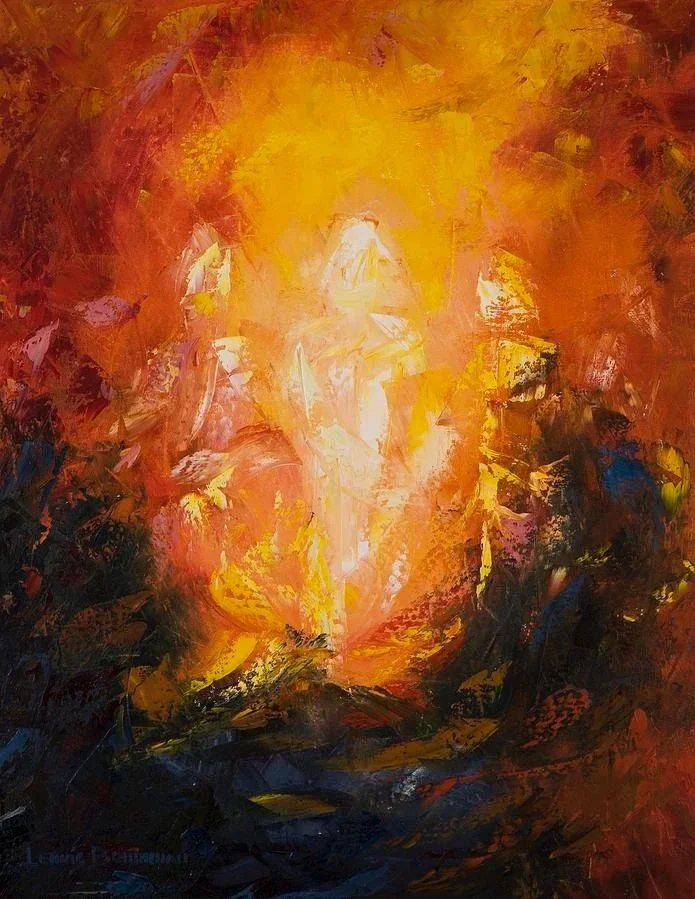
“Transfiguration” by Lewis Bowman
Exodus 24:12-18 | Psalm 2 | 2 Peter 1:16-21 | Matthew 17:1-9
Introduction: Epiphany
On the opening and closing Sundays of the Epiphany season we hear the first direct speech of God since Mt. Sinai! At Jesus’ baptism and transfiguration, the Father declares to us, “This is my Son whom I love, with him I am well pleased.” (Matt. 3:17; 17:5 cf. Ps. 2, etc.)
So, Epiphany begins with the baptismal revelation of the Son’s ministry and today it ends with a revelation of the consummation of his ministry - a temporary, proleptic glimpse of the glory and majesty of “the Son of Man coming in his Kingdom” (Matt. 16:28, cf. Dan. 7).
The transfiguration funds the church’s hope to follow Jesus through the dark to the dawn of the final Day (“parousia”). In today’s epistle Peter exhorts a suffering church, “you do well to pay attention to it as a light shining in a dark place.” Transfiguration: A light for the Way.
___________________
Like the events at Mt. Siani, the transfiguration of Jesus is a luminous, numinous event atop a high mountain at the intersection of heaven and earth. This Christophany outstrips our attempts to explain it, but attending to the literary real estate in which it is situated is rewarding.
Matthew has just told us Jesus is radically transforming his disciples’ assumptions of his mission as the Messiah/King. His mission to bring God’s reign on the earth will be accomplished through his death and resurrection. The path to life will run through death and out the other side.
Recall Peter response to this news? “Never, Lord...This will never happen to you!” The cross scandalizes even our best intentions. The “word of the cross” - this strange plan to over- come evil with good, to conquer through defeat - is something disciples of every age resist.
This conflict between divine and human wisdom spills over into all the lives of Jesus’ would be disciples. “If anyone would come after me, he must deny himself and take up his cross and follow me.” Discipleship, like messiahship, is redefined to be cruciform.
In this context of Peter’s struggle with the word of the cross Matthew tells us Jesus took him and the Thunder Brothers, James and John, up onto a high mountain for a Moses-like encounter with God (cf. today’s O.T. reading - Moses, mountain, cloud, glory).
Here in this liminal place between heaven & earth, the Father glorifies Jesus by word and deed. The Father transfigures Jesus “before them,” i.e. the disciples. Then the Father’s word directly addresses them, striking them with holy fear as it first did the Israelites at Sinai.
In other words, what happens here is clearly for the benefit of disciples who have just been called to a radical redefinition of their faith. To this end, the Father temporarily transforms this mountain top into a suburb of heaven to minister to the Son’s (nascent) church.
The Father “morphs” Jesus in uncreated light, so we see his coming glory. Only a week before Jesus said to his disciples, “I tell you the truth, some who are standing here will not taste death (i.e. martyrdom) before they see the Son of Man coming in his kingdom.” (16:28)
So, on this holy mountain we are given a prophetic vision of the end-time enthronement of Jesus as Lord. He will be given all authority in heaven and earth (28:18ff); and will come again in his Father’s glory bringing the final reign of God in judgement and salvation (16:27).
Michael Card puts it poetically, “Then a circle of glory will be placed upon his brow//and he’ll come to reign forever//though it may not seem so now//And then all our tears and troubles will seem oh so like a dream//as we stand before the glory of our Savior and our King.”
“Though it may not seem so now,” is something Peter addresses some thirty years later. He’s writing to a suffering church made resident aliens in the Roman empire by the Gospel of the Kingdom. Jesus has not yet come back & false teachers were telling them to scrap this hope.
Peter responds, “For we did not follow cleverly devised stories when we told you about the coming of our Lord Jesus Christ in power, but we were eyewitness of his majesty.” The apostolic witness was no fairy tale; it was good news about this world, seen with their own eyes!
After the Father’s deed of transfiguration so we would see Jesus, the Father speaks because he wants us to listen to Jesus. From the bright ominous Sinai-like cloud the Father declares, “This is my Son, whom I love, with him I am well pleased, listen to him.”
The Father quotes Himself, citing words chiefly from Psalm 2 (cf. Gen. 22). This Psalm begins with the nations and rulers of the earth revolting against God and His anointed king (i.e. Messiah). It concludes warning them to pay homage to this king or face certain defeat.
In the middle of the Psalm, the God of Israel declares at the installation of his king on his holy mountain, “You are my Son, today I have become your Father. Ask me and I will make the nations your inheritance, the ends of the earth your possession” (cf. Matt. 28:18ff).
The Father’s voice here directly affirms that Jesus is the very Son described by the Psalmist. This proclamation means that the kingdom of this world is destined to become “the kingdom of our Lord and of his Christ, and he will reign forever and ever” (Rev. 11:15).
So here, both the deed of God - transfiguring Jesus before the disciples - and the word of God - declaring Jesus as his beloved Son - work together to interpret and illuminate each other. Together they reveal the identity, mission and destiny of Jesus - and so this cosmos!
But there remains one last word to heed. The Father gives us this final imperative, “Listen to him!” Listen to him regarding what? After all, in this episode the otherwise loquacious Jesus has not yet said a word. This silence draws our attention back to the larger context.
What are the disciples not hearing/heeding? Jesus’ words regarding the cross as the path to kingdom glory. And because we, like Peter, “do not have in mind the things of God, but the things of men,” it takes the voice that formed the world to form us to be faithful disciples.
Now if the Father’s deed of transfiguring Jesus displays his final glory, then the Father’s word regards Jesus’ suffering cross. The Father wants disciples to know Jesus’ suffering love for the sake of the world is not incompatible with his coming rule of love over it.
And neither is ours. So, the Father gives us this “sneak preview” as an assurance of where the path of Jesus finally leads us all. It is a temporary preview of the eternal power, life and glory that will follow the weakness, death and shame of the cross.
Paul says, “We share in his sufferings in order that we may also share in his glory,” So a suffering church should not think that something has gone wrong. Indeed, in the absence of suffering, we might wonder if something has gone wrong (“a servant is not above master”)!
As we come to hear this word of the cross, we have a greater need to also see the final glory of Jesus. The way of the cross without this hope is unsustainable. We find ourselves with duty and difficulty without desire and delight.
The book of Hebrews says of Jesus himself, “...for the joy set before him he endured the cross.” We cannot sustain cruciform discipleship without hope. We need the “capital” of a joyful hope to fund us as we follow Jesus in his Way.
Like Peter’s churches, we live as resident aliens in the penultimateEmpires of the world. By God’s grace we, like the first disciples, are learning to listen to Jesus’ word of the cross. And it is the Transfiguration that continues to fund our hope for his eternalKingdom.
_____________
Conclusion: Lent
This week on Ash Wednesday churches all around the world will gather in order to set out on the forty-day journey of Lent. This is a journey in which we are called to follow Jesus afresh all the way to his Good Friday cross.
This 40-day trek begins with ashes - a sign of our sin and mortality; and it ends with a cross and empty tomb - where our sin and mortality are overcome by our God! To set out on this journey is to commit to personal and corporate repentance and renewal in anticipation of Easter.
The way ahead, the way of the cross, is dark and difficult. And so on this last Sunday of Epiphany, we are given a Light for the Way. May this light give you hope; hope “until the Day dawns and the morning star arises in your hearts!” (II Pet. 1:19)
There is a joy in the journey
There’s a Light we can love on the way
There is a wonder and wildness to life
And freedom for those who obey
And all those who seek it shall find it
A pardon for all who believe
Hope for the hopeless
And sight for the blind
To all who’ve been born of the Spirit
And who share incarnation with Him
Who belong to eternity stranded in time
And weary of struggling with sin
Forget not the hope that’s before you
And never stop counting the cost
Remember the hopelessness
When you were lost
There is a joy in the journey
There’s a Light we can love on the way
There is a wonder and wildness to life
And freedom for those who obey
“Joy in the Journey” by Michael Card
*For the many details not addressed in this homily/post, I have found the following especially helpful. “The Transfiguration of Jesus” by John Paul Heil; “Transfiguration” by Dorthy Lee; “Seven Ways of Looking at the Transfiguration” by Sarah Hinlicky Wilson, and “I & 2 Peter” by Douglas Harnick. (“Stay thirsty my friends!”)