
Revolution of Values
Fourth Sunday after the Epiphany
by Hunter Greene
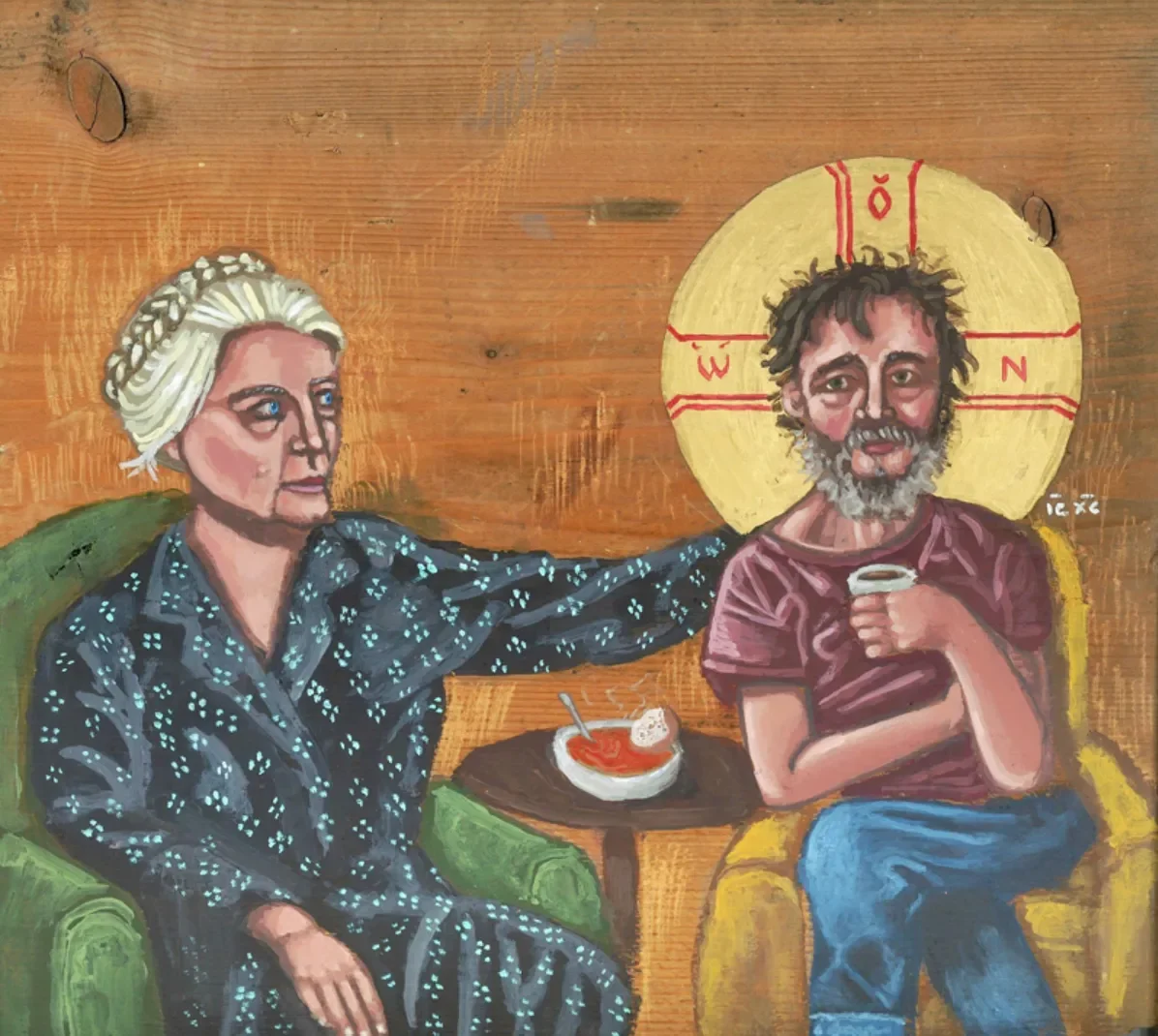
“Dorothy Day with Homeless Christ,” by Kelly Latimore
Micah 6:1-8 | Psalm 15 | 1 Corinthians 1:18-31 | Matthew 5:1-12
After taking a break from formal ministry, I’ve spent the last few years working as a community organizer. Much of my work can be summarized as helping people come together to create and lead the change they want, or sometimes even need, to see in their disinvested and under-resourced communities. I’ve found organizing to be challenging work but rewarding work, as there have been few blessings in my life that compare to the joy of seeing ordinary people take ownership of the decisions that are made that affect, and quite literally shape, the conditions of their lives.
However, as you might expect, this work also means that I’m subject to hearing words like “protest,” “manifesto,” and “revolution” thrown around a lot. There is no shortage of people wanting the world, the country, and their community to change. But what I’ve learned about such words is that they are hardly ever meant to carry much weight in wielding any sort of real political consequences, but rather, they are used to force a particular audience to reckon with an apocalyptic reality that too many have seemingly been able to ignore. Depending on where we find ourselves on the social hierarchy of the haves and have nots, such polarizing words are sure to conjure up fear or defensiveness if we have access to power and hope, or perhaps even optimism, for those subjected to powerlessness. Yet, one thing is for certain: these words demand that a side is taken and a course of action chosen, come what may.
I’ve often wondered how Jesus’ Sermon on the Mount, specifically the Beatitudes section, served as a means of organizing and mobilizing his hearers. At this point in Matthew’s narrative, Jesus has already announced his public ministry, garnered a handful of earnest disciples, and seemingly knows the looming consequences of his teachings after receiving news of John the Baptist’s imprisonment. Like John, Jesus’ purpose up to this point is clear: “Repent, for the Kingdom of Heaven is at hand.” These are the words of protest. Jesus is making known his objections to the oppressive reign of empire and reminding his hearers that the reign of God governs by a different set of values, practices, and social arrangements.
If Jesus expresses his public protest in chapter 4, then we might see his Sermon on the Mount in Matthew 5-7 as his manifesto, particularly his reflections with the Beatitudes (Matthew 5:1-12). In general, a manifesto is a “statement of a person or group’s beliefs, aims, and policies, especially their political beliefs.”1 In this way, Jesus is not musing about the individual piety of those who find it in their heart to be poor in spirit, meek, humble, merciful, and gentle – all of which oppressive regimes valorize as personal attributes for a “respectable” citizenry they can later weaponize to maintain power. Rather, Jesus is offering his hearers a deeply political and economic rendering of how God’s Kingdom distributes resources, serves justice, and secures peace.
Lest we mistake the material implications of Jesus’ claims in the Beatitudes, he leaves us no doubt that God’s reign will bring about material reparations to those who have been exploited, oppressed, wounded, and neglected by the empires of this age. They will reap rewards as stakeholders in the reign of God, receiving comfort and mercy, inheriting land, and having their spirits renewed to see and live as God’s children. Further, Jesus’ manifesto, as it were, has chosen the very people the world has rejected to be the foundation of God’s reign on earth as it is in heaven.
No protest or manifesto is without its aims, its goals and ends. This, I think, is where Jesus’ revolution – a revolution of ordinary people making ordinary change in ordinary communities – comes into play. Much to the dismay of those who see bloodshed and immediate gratification as the only markers of real revolution, Jesus places his revolutionary project in the life of the people of God. Just as the prophets before him had done, Jesus is summoning his followers, his church, to be those who “do justice, love kindness, and walk humbly with God” and who possess enough faith to leave all outcomes, whether our efforts lead to progress or persecution, in his crucified hands.
Such a political philosophy, namely the politics of the cross, is likely to be dismissed as mere “foolishness” or a “stumbling block” to those in the business of activism, philanthropy, or the third sector. But while we believe that “God chose what is foolish in the world to shame the wise,” we are not absolved of our responsibility to intervene in the face of injustice or act when our neighbors are in pain. On the contrary, the Beatitudes should serve as our rules of engagement for those of us seeking to participate in the reign of God.
In the wake of federal agents murdering citizens in broad daylight, our immigrant neighbors facing increasingly more discrimination and terror, the current administration threatening war over imperial conquest, our communities bursting at the seams with fear and distrust, and our democratic system of checks and balances getting weaker by the day, now would be a great time for a revolution. However, we deceive ourselves if we think a regime change is all we need to restore “order” and “peace” in our country. For a lot of folks in our communities and across the globe, this is yet another routine experience of the American empire, even if many of us are scandalized at the thought that oppression could touch our lives too.
Empires change their leaders. Their policies change emphases. They even change the intensity with which they target and marginalize groups of people, land, and resources for their own benefit. But the one thing empires don’t change is their motive: Power. In a hot political climate such as ours, the temptations to either moderate our politics out of the public eye or escalate them into a zero-sum war are often too strong to resist. Yet, I hold out hope that the people of God see our place, in this moment, as those who can maintain both our praxis of the radical and nonviolent revolutionary politics of Jesus and our commitment to hear and love our neighbors and our enemies through the most strident of disagreements. We can do both.
To preserve this prophetic tradition, we do well to remember that the transformation of the world and its systems must start with the transformation of our own souls and values. For such change, we rely on the guidance of the Spirit who teaches us how to become the Body of Christ, broken and shared for the world. May we learn to trust the work of the Spirit, at the Spirit’s pace, for our own good and the good of the world. Doing so might lead us to the “revolution of values” that Dr. King so aptly describes in his book, “Where Do We Go From Here: Chaos or Community.” I leave you with his prophetic words:
“A true revolution of values will soon look uneasily on the glaring contrast of poverty and wealth. With righteous indignation, it will look at thousands of working people displaced from their jobs with reduced incomes as a result of automation while the profits of the employers remain intact, and say: “This is not just.” It will look across the oceans and see individual capitalists of the West investing huge sums of money in Asia, Africa and South America, only to take the profits out with no concern for the social betterment of the countries, and say: “This is not just.” It will look at our alliance with the landed gentry of Latin America and say: “This is not just.” The Western arrogance of feeling that it has everything to teach others and nothing to learn from them is not just. A true revolution of values will lay hands on the world order and say of war: “This way of settling differences is not just.” This business of burning human beings with napalm, of filling our nation’s homes with orphans and widows, of injecting poisonous drugs of hate into the veins of peoples normally humane, of sending men home from dark and bloody battlefields physically handicapped and psychologically deranged cannot be reconciled with wisdom, justice and love. A nation that continues year after year to spend more money on military defense than on programs of social uplift is approaching spiritual death. America, the richest and most powerful nation in the world, can well lead the way in this revolution of values … There is nothing to keep us from remolding a recalcitrant status quo with bruised hands until we have fashioned it into a brotherhood.”