
2026: Sustaining Witness: Faithful Resistance in Troubled Times
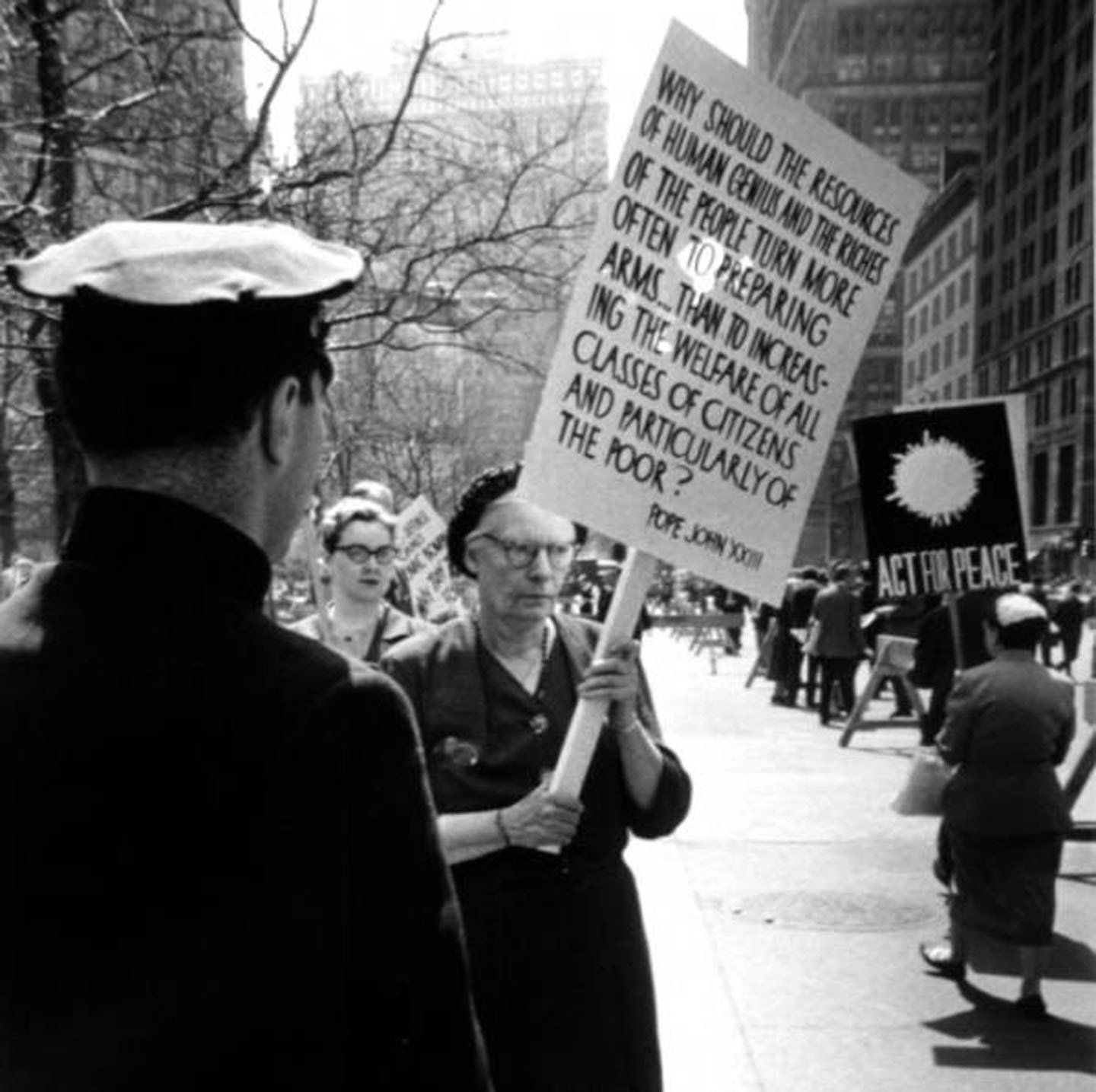
“Dorothy Day at City Hall” where she was arrested for protesting the mandatory “Operation Alert” civil defense drill (April 17, 1959). Photo by Felton Davis is licensed under CC BY 2.0.
Thursday, July 9 - Saturday, July 11, 2026
Englewood Christian Church
57 N Rural St, Indianapolis, IN 46201
Look hard for ways to make little moves against destructiveness (André Trocmé, 1901-1971)
From the beginning, the Ekklesia Project has sought to encourage and enable followers of Jesus to bear faithful witness to the reign of shalōm he proclaimed and embodied. In every time and place, the faithful proclamation of the gospel must be “good news to the poor,” seeking freedom for the imprisoned, healing care for the sick and injured, and liberty for the oppressed (Luke 4:18). By its very proclamation and embodiment this gospel exposes the pretensions of empire and cuts against the vested interests of the powers.
In our present cultural moment in the United States, dominated by government-sanctioned performative cruelty toward the very people at the center of Jesus’s gospel proclamation, faithfulness becomes—and in fact demands—resisting the powers on behalf of these little ones (Matthew 25:40). Such resistance begins with and centers on those acts of mercy named by Jesus: feeding the hungry and offering drink to the thirsty, welcoming the stranger, clothing the naked, caring for the sick, and visiting the imprisoned (Matthew 25:31-46).
The turmoil of recent months—the codification of climate change denial, government-funded racism and xenophobia, the specter of perpetual war, and active hostility toward the poor (among other things)—has given rise to a sense of urgency among followers of Jesus and led to questions about whether faithfulness in this moment calls for more. How do followers of Jesus discern how best to bear Christ in their places on earth? Are radical hospitality, corporal and spiritual acts of mercy, and praying for the victims of the powers and the enemies of the gospel sufficient, or does fidelity in this moment call also for acts of resistance, which may include certain forms of civil disobedience?
These basic questions point to other, specific practical matters: What personal and corporate devotional and liturgical practices animate and sustain faithful witness? Can resistance be an act of neighbor-love, not only toward those who are oppressed, but also toward those who oppress them? What purposes does resistance serve—that is, what is its telos? Where can it be learned, and from whom? The 2026 Gathering will offer teaching, facilitate conversation, and provide opportunities to engage these questions.
Joel Shuman, Gathering Planning Team Leader
Jim McCoy, Worship Coordinator
Christopher Jackson, Harding University, Lectio Divina Leader
Preachers
Katy Lines, Pastor, Englewood Christian Church, Indianapolis, IN
Rev. Dr. Rodney Sadler, Associate Professor of Theological Studies & Director of the Center for Social Justice and Reconciliation, Union Presbyterian Seminary, Charlotte, NC
Ragan Sutterfield, Ekklesia Project Board Chair, Associate Rector, Christ Episcopal Church, Little Rock, AR
Plenaries
Steve Fowl, President & Dean, Church Divinity School of the Pacific, Berkeley, CA
“Confessions of a Reluctant Resister”
On the one hand, I am as appalled as anyone by the Trump administration’s serial outrages. I admire those Christians in places like the Twin Cities and elsewhere who are helping their neighbors, who in their words and deeds are letting the powers that be know that God is not smiling on any government that acts the way the Trump administration does.
On the other hand, I recognize that the Roman empire was brutal and thrived on violence and the threat of violence. The powerful could manipulate the legal system to their advantage; if they could not manipulate it, they could avoid the consequences of breaking the law. Aside from a very few people one might call genuine friends, all others were to be treated based one whether they could do something for you or do something to you.
For all the parallels between Rome and Trump’s America, Jesus does not call his followers to resist. Instead, from the Gospels through to Revelation we read about the formation and maintenance of communities capable of faithful obedience to the gospel, capable of a common life worthy of that gospel, and capable of walking in a manner reflective of that gospel. All of those things are independent of and in most cases indifferent to any response the empire might make.
I would like us to explore way in which Christians might both demonstrably love their neighbors while at the same time avoid being captivated by the ideology of resistance.
Kelly Johnson, Fr. Ferree Chair of Social Justice & Associate Professor of Religious Studies, University of Dayton, Dayton, OH
“Peace and the State We Are in”
"Peace" is an important word for Christians and for the Ekklesia Project. So is "the state." Augustine famously characterized peace as the tranquility of order, but whose 'order' does that refer to, given that appeals to order typically serve the interests of those in power? On the other hand, in this moment, the rule of law does seem to have an important role in peace. What should replace the habits of obedience to unjust authorities of all types, for those who are committed to shalom while still embedded in structural violence? This talk will draw on practices that experiment with the image of the 'two hands of nonviolence,' one raised to stop injustice and the other extended to invite relationship, to consider how the pilgrim people can better stand in the peace of Christ at this time.
Brenna Cussen-Anglada, Saint Isidore Catholic Worker Farm, Cuba City WI, and Meta Peace Teams
“From Turtle Island to Palestine: Stories of Community and Faithful Resistance “
Amid these perilous times marked by those most vulnerable experiencing displacement, fear, and oppression, how do we practice costly solidarity with those defending communities, land, and people? And how do we root ourselves in spiritual practices that sustain us for the long haul? This session will be a time to listen to stories of creative forms of “co-resistance” that a multitude of communities -- from Catholic Workers to Palestinian farmers to secular anarchists to Catholic sisters -- are undertaking as a form of faithful resistance for the sake of collective liberation. This session will address how these communities - from the Midwest to the West Bank - are modeling what it can look like to reclaim and sustain a Christianity that renounces empire and chooses instead to creatively live in relationship with the land and with those most vulnerable.